Gallery wall layouts: 6 ideas and how to choose
Published
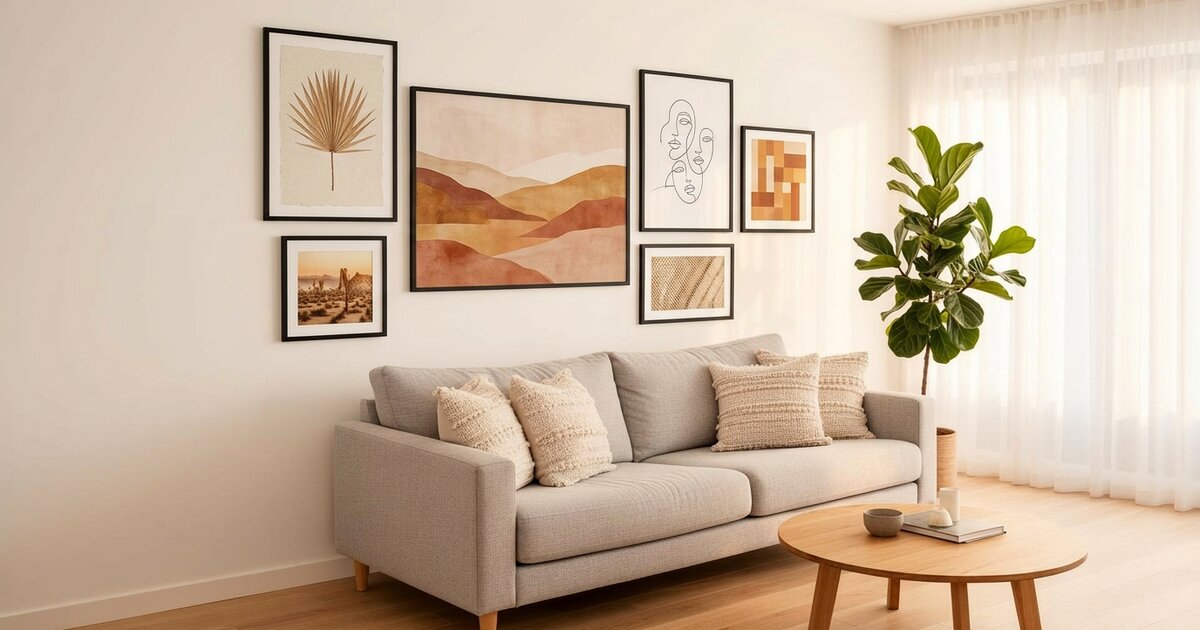
Choosing between gallery wall layouts is the step that makes the rest of a gallery wall easy. Once you know the shape, the sizes, spacing and art choices mostly follow. This guide walks through the layouts people use most, what each one does to a room, and how they map to the six layouts in WallMoment's gallery wall layout generator.
The short answer
- Grid or gallery grid: tidy and easy to hang. Best for a calm, organized look.
- Salon style: a big, mixed, floor-to-ceiling collection. Best for a lively, collected look and for large walls.
- Single row (linear): one horizontal line. Best for narrow walls above a sofa, bed or console.
- Symmetrical: a mirrored, balanced arrangement. Best for formal rooms and centered furniture.
- Vertical stack: a column of pieces. Best for tall, narrow spaces like hallways and the space beside a door.
- Diptych or triptych: two or three matched pieces. Best when you want a bold statement with little work.
- Staircase: pieces that step up or down with the stairs. Best for stairwells.
Grid layouts
A true grid places frames of the same size in even rows and columns with equal gaps. It reads as clean and intentional, and it forgives little: if one frame is a few millimeters off, you will notice. Grids work well with a limited color palette, because the repeated shapes already provide the order.
In WallMoment, the closest match is Gallery Grid, which the planner describes as a clustered arrangement with a hero piece. That is looser than a strict grid of identical frames: one larger piece anchors the group and smaller pieces cluster around it.
Salon style
A salon wall mixes sizes, orientations and often frames, and runs wide and tall, sometimes from near the floor to near the ceiling. It suits eclectic rooms and big blank walls, and it is the layout that looks best when pieces come from different places. The trade-off is that it takes more art, and the spacing between frames matters more because the eye has nothing else to hold onto.
WallMoment's Salon Style layout is described as floor-to-ceiling eclectic.
Single row (linear) layouts
A linear layout puts frames in one horizontal line, usually aligned along their centers or along one edge. It is the easiest layout to plan above a sofa, a bed or a long console, because the wall space is already wide and short. Keep the gaps consistent and decide early whether you align the tops, the centers or the bottoms.
WallMoment's Single Row layout places pieces in one horizontal line.
Symmetrical layouts
A symmetrical layout mirrors the left side of the arrangement on the right, so the whole group feels balanced around a center line. It fits formal rooms and walls with centered furniture such as a headboard, a fireplace or a console table. Mirrored layouts are also good when the art is varied, because the structure supplies the calm.
WallMoment's Symmetrical layout is a balanced mirror layout.
Vertical stack layouts
A vertical stack runs pieces in a column. It helps a tall, narrow wall feel intentional, for example in an entryway, a hallway, or beside a doorway or window. Use frames of similar width so the column reads as one shape.
WallMoment's Vertical Stack layout is a column of pieces.
Diptych and triptych layouts
A diptych is two matched pieces and a triptych is three. They are the simplest way to fill a wall with a clear, finished look, and they work well when the images belong together, such as one image split across panels or a set from the same series.
WallMoment's Diptych / Triptych layout is made of two or three matched pieces.
Staircase layouts
A staircase gallery wall follows the angle of the stairs: frames step up or down so the arrangement tracks the rise of the treads. It is a more manual job than other layouts, because the wall is angled and sightlines change as you climb. Common advice is to keep the gaps between frames equal, to measure along the angle of the stairs, and to mock up the arrangement with paper templates and painter's tape before you hang anything.
WallMoment does not have a dedicated staircase layout. Its layouts are the six described in this guide. For a stairwell, you can still use the planner to explore art styles and print sizes, but you would arrange the final hang by hand.
How WallMoment's six layouts map to common layouts
| Common layout | Closest WallMoment layout |
|---|---|
| Grid with an anchor piece | Gallery Grid |
| Salon wall | Salon Style |
| Linear row | Single Row |
| Mirrored or balanced arrangement | Symmetrical |
| Column of frames | Vertical Stack |
| Two or three matched pieces | Diptych / Triptych |
You can switch between these layouts when you regenerate a wall in the planner, so you can compare them on a photo of your own wall instead of picturing them.
How to choose a layout
- Look at the wall's shape. Wide and low suggests a single row or a gallery grid. Tall and narrow suggests a vertical stack. A large open wall suits salon style.
- Look at the furniture. Centered furniture suggests a symmetrical layout.
- Look at the art. Pieces with a shared look suit a grid, a row or a diptych. Mixed art suits a salon wall or a symmetrical arrangement.
- Decide how much work you want. A diptych or triptych is the least work. A salon wall is the most.
Once you have a shortlist, see the sizes and spacing in How to plan a gallery wall, or read the room guide for a gallery wall above a couch.
Try the layouts on your own wall
Upload a photo of your wall to the gallery wall planner and WallMoment generates a complete arrangement shown on your photo. Planning is free and does not need an account. You create a free account when you order.
FAQ
What is the most popular gallery wall layout?
There is no single most popular layout, and WallMoment does not publish usage numbers. Grids, single rows and salon walls are the arrangements people most commonly describe. Pick the one that fits the shape of your wall and the amount of art you have.
How many gallery wall layouts does WallMoment have?
WallMoment has six: Gallery Grid, Single Row, Salon Style, Symmetrical, Vertical Stack and Diptych / Triptych. You can switch between them when you regenerate your wall in the planner.
What gallery wall layout works best for a small wall?
A diptych, a triptych or a single row usually fits a small wall best, because they use few pieces and leave space around them. A vertical stack suits a narrow wall.
Does WallMoment have a staircase gallery wall layout?
No. WallMoment does not have a dedicated staircase layout. You can use the planner to explore art styles and print sizes, but the stair-stepped hang itself is done by hand.
Can I try a gallery wall layout before I buy anything?
Yes. You can upload a photo of your wall, generate an arrangement on it and switch layouts for free, with no account. You only pay if you order prints.
Related
- How to Plan a Gallery Wall: A Step-by-Step Guide
Seven steps to plan a gallery wall, and how to preview the arrangement on a photo of your own wall with WallMoment's gallery wall layout generator.
- Gallery Wall Above a Couch: Sizing and Spacing
Sizing, height and spacing rules for a gallery wall above a couch, with example sizes and how to preview the wall on your own photo.
See it on your own wall
Upload a photo of your wall and preview a gallery wall arrangement on it. Planning is free.